Every September, Pain Awareness Month puts a global spotlight on what it actually means to live with pain. Every July, Australia runs its own version of the same conversation under a different name. The two get confused constantly, and the confusion matters, because the practical advice behind each - and what genuinely helps day to day - is more useful than either the calendar entry or the headline.
This guide sets out what Pain Awareness Month is and who runs it, what the Australian data actually says about chronic pain, how it differs from National Pain Week, and what the current guidelines say helps - movement, sleep, pacing, heat and structured self-management programmes. It also covers where a topical product like Kunzea Pain Relief Cream fits, and where it doesn't, plus a clear steer on when to see a doctor.
What Pain Awareness Month is, and who runs it
Pain Awareness Month falls every September and is a US-origin observance. It was established in 2001, when the American Chronic Pain Association led a coalition called Partners for Understanding Pain - a group that grew to include more than 80 health professional and consumer organisations in its first years.1 The aim was straightforward: get pain, and the people living with it, talked about seriously, rather than treated as something to push through quietly.
Since then, the International Association for the Study of Pain and dozens of patient groups worldwide have adopted September as a shared moment to run awareness campaigns, share lived experience and push for better pain research, education and care. It isn't a single event with one governing body issuing rules - it's more a banner that pain organisations around the world gather under each year, each running their own local activities underneath it.
The Australian picture, in real numbers
Chronic pain in Australia is common, and the data on how common has been consistent for years. The Australian Institute of Health and Welfare reports that almost one in five Australians aged 45 and over - about 1.6 million people - had chronic pain in 2016.3 A separate analysis prepared for Painaustralia estimated that 3.37 million Australians of all ages were living with chronic pain in 2020, split roughly 54% women and 46% men, with more than two-thirds of working age.4 Both figures describe the same underlying reality from different angles: chronic pain is not a rare or niche condition in Australia. It sits alongside the most common long-term health issues in the country, and it is more likely in people who also live with arthritis, osteoporosis or mental health conditions.3
None of that is meant to be alarming for its own sake. It's context for why a whole month, and a whole week, exist to talk about it - and why "just push through it" was never a serious answer for the numbers involved.
Pain Awareness Month vs National Pain Week: not the same thing
This is where a lot of Australian content gets it wrong, usually by treating the two as interchangeable. They aren't.
- Pain Awareness Month is in September, is US-founded (American Chronic Pain Association, 2001), and functions internationally as a shared banner for pain organisations to run their own campaigns.1
- National Pain Week is Australia's own observance, held annually in the last week of July, and is organised specifically by Chronic Pain Australia.2 It has its own Australian campaign themes and its own advocacy focus, distinct from the US-led September event.
Why the distinction is worth making: if you're searching for Australian pain support services, statistics or advocacy, National Pain Week and Chronic Pain Australia are the more directly relevant starting point. Pain Awareness Month is still a legitimate and useful moment - it's the one with the bigger international reach and the longer history - but it isn't run by, or specifically about, Australia. Both are valid reasons to talk about pain. Neither should be quietly merged into the other.
What the guidelines say actually helps
Away from awareness campaigns, there's a reasonably consistent evidence base on what helps people manage pain day to day. None of it is a cure, and none of it works the same for everyone - but each of the following has real research behind it, not just tradition.
Movement, even in small amounts
A large overview of Cochrane reviews - 21 reviews, 381 studies, over 37,000 participants across conditions including osteoarthritis, low back pain and fibromyalgia - found that physical activity and exercise had few adverse effects and tended to improve pain severity and physical function.5 The effect sizes in individual conditions are often modest rather than dramatic, and no single "right" exercise program was identified. The practical takeaway is less about a specific routine and more about the direction: gentle, regular movement generally helps rather than harms, which runs against the instinct to protect a painful joint or muscle by avoiding it altogether.
Sleep, treated as its own problem
Pain and poor sleep feed each other - pain disrupts sleep, and poor sleep tends to make pain feel worse the next day. Australian GP guidelines (RACGP) recommend cognitive behavioural therapy for insomnia as the first-line approach to chronic sleep problems, ahead of medication.8 That's a structured, learnable approach rather than a supplement or a single bedtime trick - worth raising with a GP directly if sleep has become part of the pain picture, which it often has. Zea has covered the sleep-pain relationship and specific evening strategies in more depth elsewhere in the Health Library.
Pacing, not pushing through
Pacing means breaking activity into smaller, planned chunks rather than doing everything on a "good day" and paying for it for the next three. Healthdirect Australia describes it as a way to avoid the boom-and-bust cycle that makes flare-ups worse and more frequent.6 It sounds simple and undersells itself because of that - in practice it's one of the more consistently recommended self-management skills in chronic pain care, precisely because it's something a person can control day to day without waiting on a treatment.
Heat, for short-term comfort
Superficial heat has a real, if modest, evidence base for short-term pain relief. A Cochrane review of heat therapy for low back pain found that heat wrap therapy gave a small but significant reduction in pain over several days compared with no treatment, particularly when combined with gentle exercise - though the authors were clear the evidence base is limited and heat is not a stand-alone fix.7 That's a fair description of what heat is genuinely good for: comfort and short-term relief that can make movement or daily tasks more manageable, not a treatment for the underlying cause.

Structured self-management programmes
Australian clinical guidance increasingly frames chronic pain through a biopsychosocial lens - treating it as a mix of physical, psychological and social factors rather than a single mechanical problem, and prioritising supported self-management alongside any medical treatment.6 Painaustralia and Chronic Pain Australia both maintain directories of pain services and peer-support programmes for people wanting a structured, guided approach rather than working it out alone.
Where a topical cream legitimately fits, and where it doesn't
It's worth being direct about this, because it's easy for a pain-relief brand to overstate its place in a conversation about chronic pain, and that's not what this article is for.
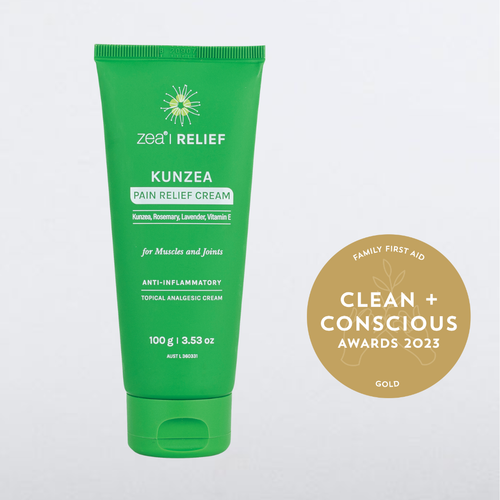
Chronic pain is a medical condition. It is not something a cream, a heat pack or any single product treats, manages or cures, and nothing here should be read as suggesting otherwise. What a product like Kunzea Pain Relief Cream can reasonably offer is narrower and more specific: it's registered with the ARTG as a listed medicine (AUST L 360 331) for uses including relief of mild rheumatic aches and pains, mild joint pain and soreness, and muscle pain and soreness, applied topically as needed. That's a real, defined role for everyday muscular discomfort - not a claim about resolving a long-term pain condition.
Heat sits in a similarly modest, well-evidenced spot: comfort and short-term relief, useful alongside movement rather than instead of it. Zea's Wearable Heat Pack is a wearable, reusable version of exactly the heat-wrap approach described in the Cochrane review above - a practical way to apply that specific, evidence-supported comfort measure to the lower back and hips during daily activity, without positioning it as anything more than that.

Where neither belongs is as a stand-in for medical care. If pain is persistent, worsening, or changing in character, that's a conversation for a GP, not a shelf of products.
How to talk to your GP about pain
A surprising number of people under-report pain to their doctor, either because they've adapted to it or because they're not sure what's useful to say. A few things tend to make the conversation more productive:
- Describe the pattern, not just the pain. When it's worse, when it's better, what makes it flare, how long flares last.
- Bring a simple pain diary if you can. Even a week of notes on intensity and triggers gives a GP more to work with than a single description on the day.
- Mention sleep and mood. Both are directly relevant to chronic pain management and are often left out because they feel like a separate topic.
- Ask about the biopsychosocial approach. If a GP hasn't raised pacing, gentle exercise or a referral to a pain service or physiotherapist, it's a reasonable thing to ask about directly.
See your doctor if pain persists for more than a few weeks, is worsening, or is stopping you from doing normal daily activities. That applies whether the pain is new or long-standing - chronic pain can still change in ways that warrant a fresh assessment, and self-management strategies work best alongside proper medical oversight, not instead of it.
Where to get support
Two Australian organisations run the support infrastructure behind National Pain Week and the broader pain conversation year-round, and both are listed in the references below rather than linked inline, in keeping with how this Health Library treats support and advocacy bodies: Painaustralia and Chronic Pain Australia. Both maintain service directories, peer-support information and current advocacy campaigns for anyone wanting a next step beyond this article.
FAQ
Is Pain Awareness Month the same as National Pain Week?
No. Pain Awareness Month is a US-founded observance held every September. National Pain Week is Australia's own observance, held in the last week of July and organised by Chronic Pain Australia. They run independently of each other.12
How many Australians actually live with chronic pain?
Estimates vary by methodology and age group. The AIHW puts it at almost one in five Australians aged 45 and over (about 1.6 million people) using 2016 data.3 A 2020 estimate prepared for Painaustralia put the figure at 3.37 million Australians of all ages.4
Can a cream or heat pack manage chronic pain on its own?
No, and this article doesn't suggest it can. Chronic pain is a medical condition best managed with a GP and, where relevant, a pain specialist or physiotherapist, using an evidence-based combination of movement, sleep, pacing and other self-management strategies. Topical products like Kunzea Pain Relief Cream have a defined, narrower role for everyday muscular and joint discomfort within their ARTG listing - not a role as a chronic-pain treatment.
What's the single most evidence-backed self-management strategy?
There isn't one single winner - the guidelines point to a combination. But gentle, consistent movement and pacing (avoiding the boom-and-bust cycle) come up most consistently across Cochrane reviews and Australian clinical guidance alike.56
Related reading
For more on specific pain conditions and natural approaches within their evidence base, see Zea's guides on building a natural arthritis pain routine, whether Kunzea oil helps with arthritis, how sleep, pain and inflammation are connected, and five evidence-based sleep strategies for people living with pain. If liniments and topical rubs are new territory, this explainer on what a liniment actually is is a useful starting point, and the guide to Kunzea oil and arthritis covers the sourcing and composition behind Zea's own formulations. Zea's full range of wearable and reusable heat packs is also worth a look if heat therapy is a strategy you haven't tried yet.
References
Sources open in a new tab so you don't lose your place.
- 1. American Chronic Pain Association. Pain Awareness. View source
- 2. Chronic Pain Australia. National Pain Week 2026. View source
- 3. Australian Institute of Health and Welfare. Chronic pain in Australia, Summary. View source
- 4. Painaustralia. Painful Facts (citing Painaustralia/Deloitte, The Cost of Pain in Australia, 2019). View source
- 5. Geneen LJ, et al. Physical activity and exercise for chronic pain in adults: an overview of Cochrane Reviews. Cochrane Database of Systematic Reviews, 2017. View source
- 6. healthdirect Australia. Options for managing chronic pain. View source
- 7. French SD, et al. A Cochrane review of superficial heat or cold for low back pain. Cochrane Database of Systematic Reviews, summarised via Cochrane Evidence. View source
- 8. Sleep Primary Care Resources Australia (RACGP-aligned insomnia guidance). Resources - Insomnia. View source